Free Habit Tracker & Implementation Intention Template (2026): 66-Day Automaticity Curve, Never-Miss-Twice Rule & Interactive Scorecard
Most habit trackers fail by Week 2 because they track 15 vague wishes (“work out more,” “read daily”) and treat a single missed Tuesday as a broken streak. Grounded in Phillippa Lally’s 66-day automaticity curve (University College London, 2010), Peter Gollwitzer’s If-Then implementation intentions (d = 0.65), and BJ Fogg’s 2-minute Tiny Habits floor, this template pairs a 31-day keystone habit grid with an interactive automaticity scorecard. Model your habit load below, print the 1-page A4/US Letter sheet, or use the automated Google Sheets edition.
Interactive 66-Day Habit Automaticity & Implementation Intention Scorecard
Configure your active keystone habit count, weekly consistency target, habit complexity, and current phase on the Lally (2010) curve. The live scorecard and 4-column weekly matrix update immediately.
| Keystone Habit & Domain | If-Then Implementation Cue (Gollwitzer, 1999) | 2-Minute Minimum Floor (Fogg, 2019) | Weekly Target & Buffer |
|---|---|---|---|
| 1. Cognitive Anchor | If 08:00 coffee poured → 90 min deep work before inbox | Open spec doc & write 3 sentences before checking Slack | 6/7 days (86% · 1 slip max) |
| 2. Physical Anchor | If 17:30 laptop closed → 30 min strength or brisk walk | 15 air squats + 10 push-ups beside desk | 6/7 days (86% · 1 slip max) |
| 3. Synthesis Anchor | If 21:15 phone on hallway charger → Read 15 pages print book | Read 1 full page in bed before lights out | 6/7 days (86% · 1 slip max) |
| 4. Shutdown Anchor | If 16:45 desk cleared → Write tomorrow’s Top 3 MITs | Write #1 morning priority on sticky note | 6/7 days (86% · 1 slip max) |
What’s in the template
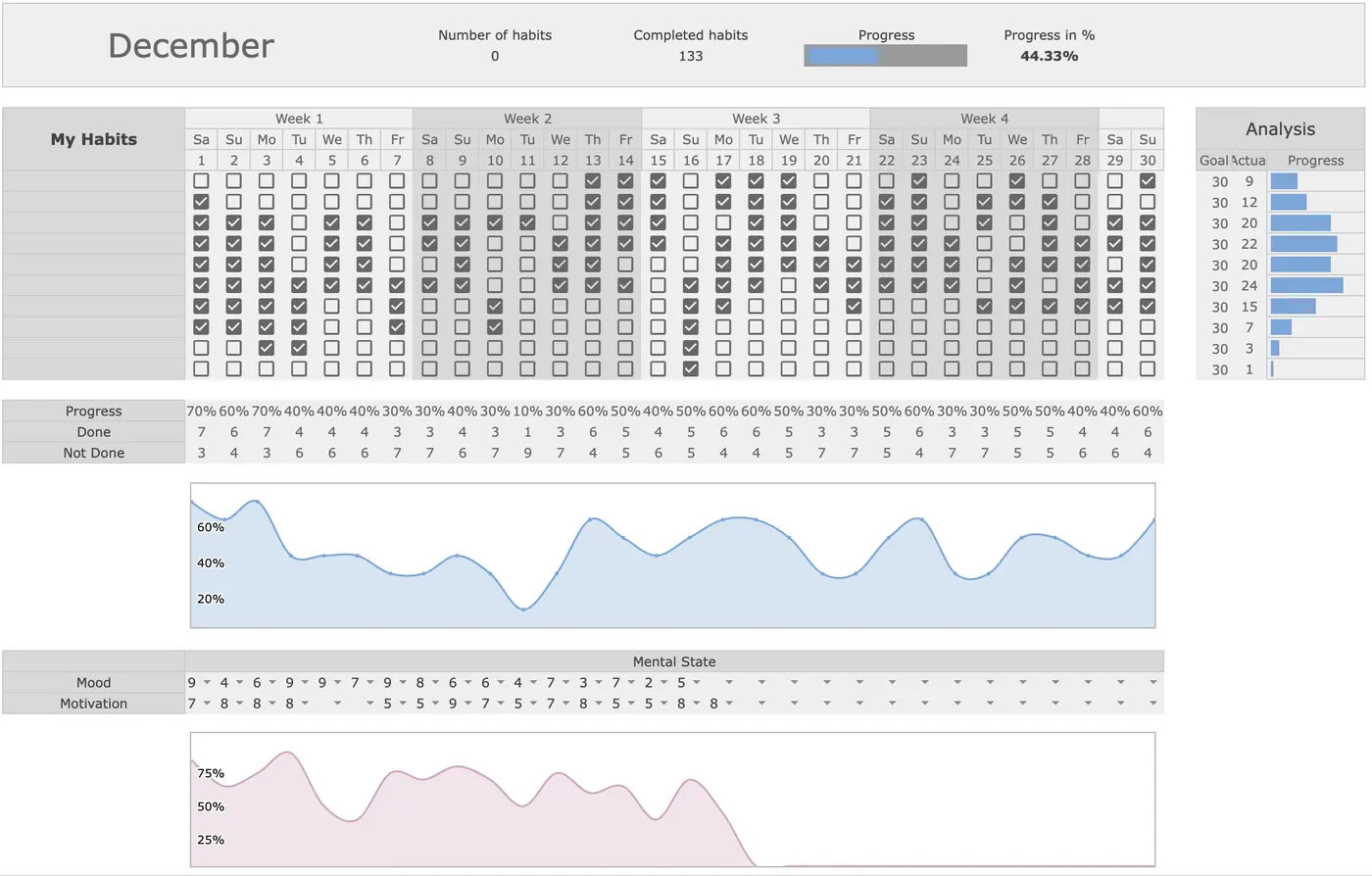
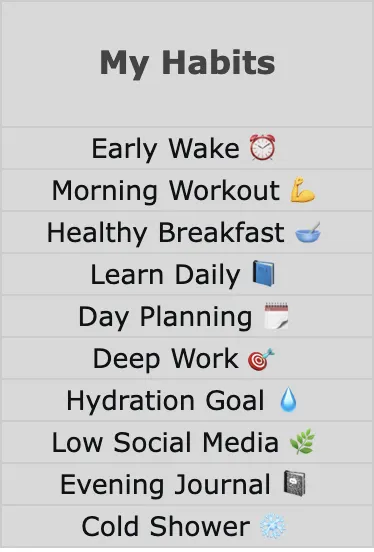
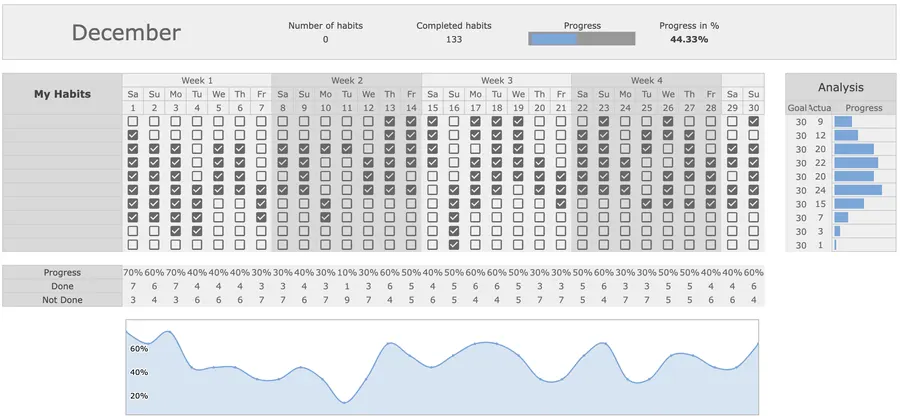
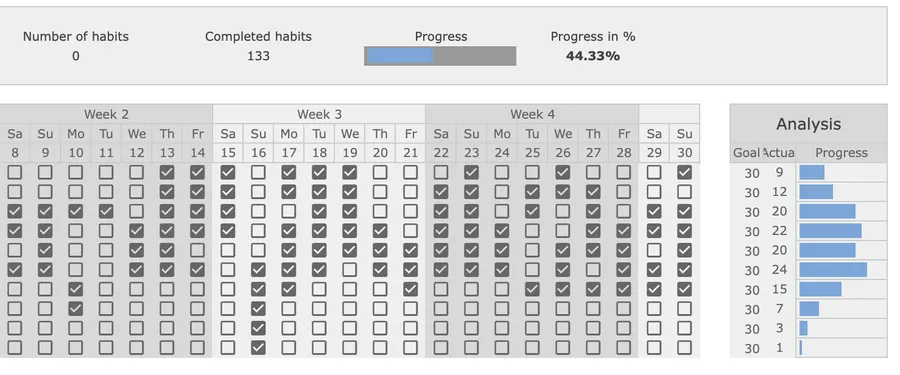
- 31-Day Keystone Checkbox Matrix: One row per habit and one checkbox per calendar day (1–31), engineered around a high-retention cap of 3 to 5 keystone behaviors.
- Gollwitzer If-Then Cue Slots: Dedicated space next to every habit to lock in your situational trigger (“If situation X arises, then I will perform response Y”) before the month begins.
- BJ Fogg 2-Minute Minimum Viable Floor: Defines a sub-2-minute emergency version for every habit so travel, illness, or late meetings never trigger a two-day streak break.
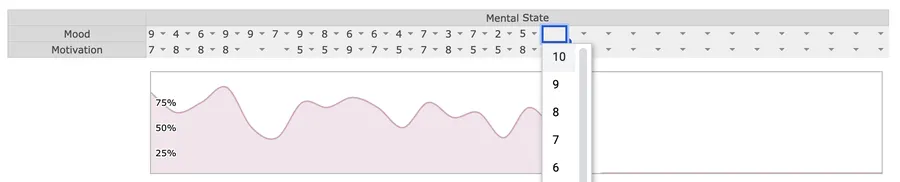
- Automated Google Sheets Streaks & Charts: Every ticked box updates your monthly completion percentage, horizontal progress bar, and 66-day automaticity curve across 12 monthly tabs.
How to set up a habit tracker that survives Week 2
- Cap your active grid at 3 to 5 keystone habits: Pick 1 cognitive deep-work anchor, 1 physical movement or sleep anchor, and 1 evening shutdown routine. Defer secondary habits until your current rows reach 85% automaticity.
- Attach every habit to a fixed daily anchor: Replace vague intentions (“meditate daily”) with an observable event trigger (“After pouring my 07:30 coffee, sit on the living room chair for 5 minutes”).
- Pre-commit your 2-minute floor: Write down what counts as a legal check mark on an exhausting day (1 page read, 10 push-ups, or writing tomorrow’s #1 MIT).
- Audit every Sunday during your Weekly Review: Pair your tracker with our Weekly Review & GTD Reset Template and Weekly Planner to redesign any cue that dropped below 5 days/week.
Up close
The 66-Day Automaticity Curve by Habit Complexity (Lally et al., 2010; Gollwitzer, 1999; Fogg, 2019)
In Phillippa Lally’s longitudinal study at University College London, habit automaticity followed a steep initial climb followed by a plateau (an asymptotic power curve) spanning 18 to 254 days. Use the benchmark table below to calibrate your expectations and 2-minute floor by habit complexity:
| Habit complexity tier | Example If-Then cue (Gollwitzer, 1999) | Days to 95% automaticity | 2-minute minimum floor (Fogg, 2019) | Primary failure mode & fix |
|---|---|---|---|---|
| Tier 1 · Micro / Environmental Anchor (<2 min) | “If 07:00 feet touch floor → Drink 300 ml water at kitchen sink” | 18–42 days (Fast plateau) | Take 3 sips of water from bedside glass | Forgetting cue → Place filled glass on nightstand at 21:30 |
| Tier 2 · Moderate Daily Routine (15–30 min) | “If 21:15 phone goes on hallway charger → Read 15 pages in bed” | 45–66 days (Study median: 66 d) | Read 1 full page before turning off lamp | Late-night screen drift → Charge phone outside bedroom |
| Tier 3 · High-Friction Deep Habit (45–90 min) | “If 08:00 coffee poured → 90 min deep work on MIT 1 before inbox” | 84–254 days (~94 d typical) | Open project file & write 3 sentences before Slack | Morning inbox hijack → Pre-stage open document the evening before |
| Tier 4 · Evening Shutdown & Reset (10 min) | “If 16:45 alarm sounds → Clear desk & lock tomorrow’s Top 3 MITs” | 35–60 days | Write tomorrow’s #1 priority on a physical card | Meetings running past 17:00 → Move shutdown trigger to 16:30 |
Format Comparison: Printable 31-Day PDF vs. Automated Google Sheets vs. Notion Database vs. Mobile App
| Tracker format | Best for | Setup time | Cognitive & retention trade-off |
|---|---|---|---|
| Printable 31-Day PDF (A4 / Letter) | Desk pad & wall visibility | 1 min | Zero screen distraction and high visual salience; no automatic streak math |
| Google Sheets (Automated) | 66-day curves & 12-month analytics | 2 min | Calculates % completion, streak bars, and monthly rollups automatically |
| Notion Daily Log Database | All-in-one workspace + phone check-in | 3 min | Fast mobile checkboxes; wide 31-column grids require horizontal scrolling |
| Gamified Smartphone Apps | Push-notification reminders | 5 min | High notification fatigue; exposes you to social feeds during morning/evening cues |
Why tracking 3 to 5 keystone habits beats a 15-row tracker
When ambitious professionals build a new spreadsheet, they frequently list 12 to 18 daily habits: cold showers, journaling, macros, language flashcards, inbox zero, reading, and stretching. Behavioral psychology explains why that layout collapses within 10 days: every unautomated behavior draws from finite prefrontal executive control before reaching its automaticity asymptote. By restricting your active grid to 3 to 5 keystone habits (one cognitive anchor paired with our Time Blocking Template, one physical movement anchor, and one evening shutdown paired with our Daily Planner), you protect executive bandwidth and achieve an 85%+ monthly completion rate.
The behavioral science behind Habit Trackers: Automaticity curves, Implementation Intentions, and Tiny Habits (Lally et al., Gollwitzer, and Fogg)
Three peer-reviewed findings separate an evidence-based habit protocol from motivational folklore. First, health psychologist Phillippa Lally and colleagues at University College London tracked 96 participants forming daily eating, drinking, and exercise behaviors over 84 days using the Self-Report Habit Index (SRHI); automaticity followed an asymptotic curve requiring a median of 66 days (range: 18 to 254 days) to reach 95% of its asymptote, and crucially, missing a single opportunity did not measurably impair the habit-formation trajectory (Lally et al., 2010, European Journal of Social Psychology). That empirical resilience is why our scorecard defaults to a 6-days-per-week (86%) Never-Miss-Twice standard rather than brittle 100% perfectionism. Second, psychologist Peter M. Gollwitzer demonstrated across 94 independent studies that forming an explicit implementation intention (“If situation X is encountered, then I will initiate goal-directed behavior Y”) produces a medium-to-large meta-analytic effect size of d = 0.65 on goal attainment by transferring action control from conscious deliberation to environmental cues (Gollwitzer, 1999, American Psychologist). Third, Stanford behavior scientist BJ Fogg showed in the Fogg Behavior Model (B = MAP) that when motivation dips, scaling the target behavior down to a sub-2-minute Minimum Viable Action anchored to an existing routine preserves identity and cue-response continuity (Fogg, 2019, Tiny Habits).
Frequently asked questions
Is this habit tracker and implementation intention template free to download and print?
Yes. You can model your 66-day automaticity curve in the interactive scorecard on this page, copy the Markdown/Notion table, or print the 1-page 31-day A4/US Letter PDF sheet for free. If you want automated progress bars, streak counters, and 12 monthly tabs in Google Sheets, the Focus Protocol Habit Tracker is a one-time $9 purchase.
Why does habit formation take 66 days instead of 21 days?
The “21-day myth” came from casual observations by plastic surgeon Maxwell Maltz in 1960, not empirical habit research. When Phillippa Lally and colleagues at University College London (2010, European Journal of Social Psychology) tracked 96 adults building daily habits, automaticity followed an asymptotic curve taking a median of 66 days (ranging from 18 days for simple hydration habits to 254 days for complex exercise routines).
What is the Never-Miss-Twice rule, and is it backed by science?
Yes. Lally et al. (2010) proved statistically that missing a single opportunity to perform a behavior had no significant impact on long-term automaticity gains, whereas consecutive misses eroded cue-response strength. The Never-Miss-Twice rule operationalizes this finding: if travel or an emergency breaks your habit on Tuesday, executing at least your 2-minute minimum floor on Wednesday preserves the neural pathway.
How do Gollwitzer’s If-Then implementation intentions double follow-through?
Psychologist Peter Gollwitzer (1999, American Psychologist) demonstrated across 94 studies (effect size d = 0.65) that specifying an environmental cue in the format “If situation X arises, then I will perform response Y” delegates behavioral initiation from conscious willpower to automatic cue detection. Instead of writing “Read every night,” write “If it is 21:15 and I place my phone on the hallway charger, then I will read 10 pages in bed.”
How many keystone habits should I track at once without burning out?
Track 3 to 5 keystone habits at a time: ideally 1 cognitive/deep-work anchor, 1 physical movement/sleep anchor, and 1 evening shutdown/planning anchor. Tracking 12 or 15 habits simultaneously triggers decision fatigue and turns a 30-second evening check-in into an administrative chore that gets abandoned by Week 2.
Want the complete Focus Protocol system?
Get the automated Habit Tracker for Google Sheets ($9), or combine it with our Weekly Planner, Weekly Review Template, Goal Tracker, Task Tracker, and Finance Tracker in the All-in-One Bundle ($29).